

Course Description
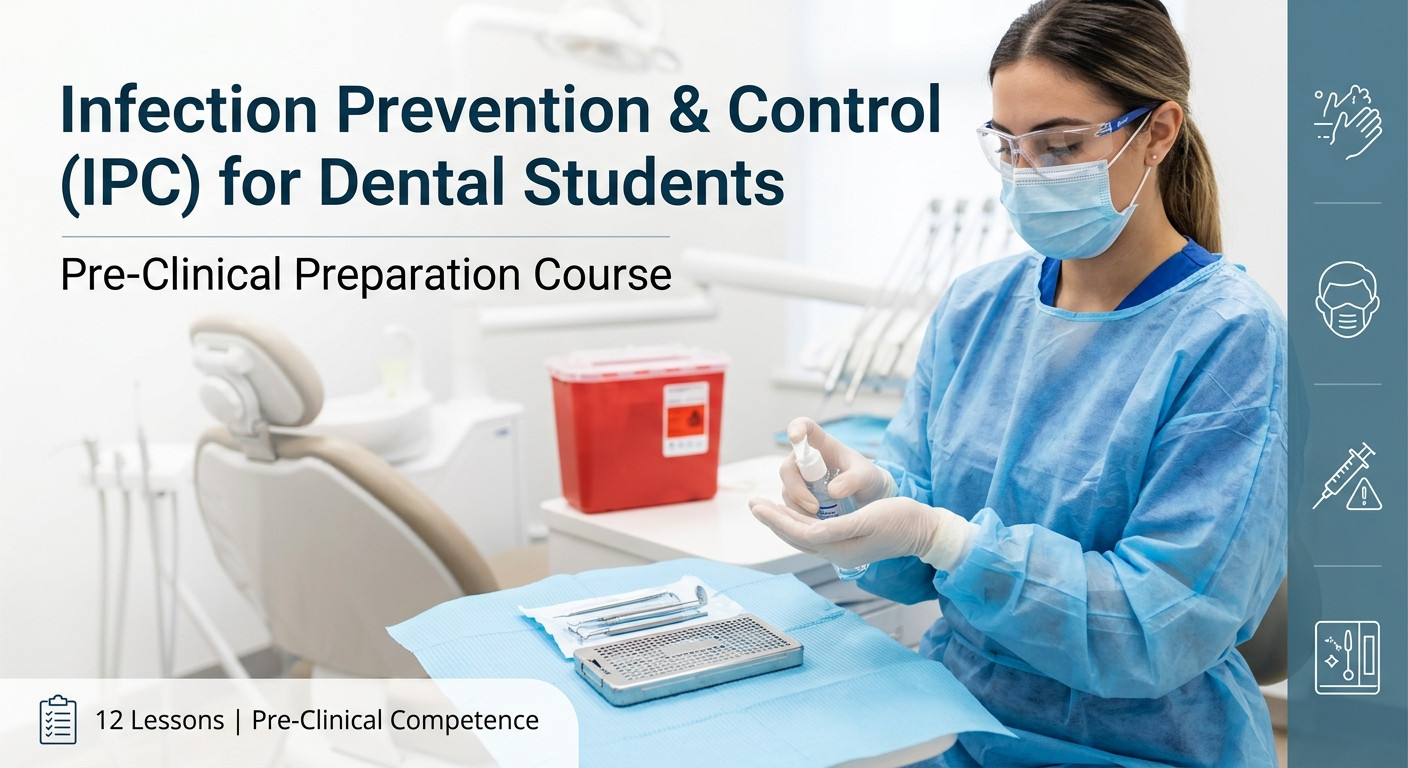
This pre-clinical Infection Prevention and Control (IPC) course prepares dental students for safe entry into clinical practice. Across 12 lessons, students learn to apply standard precautions, perform hand hygiene, use personal protective equipment, handle sharps safely, respond to occupational exposures, and follow essential cleaning, disinfection, and sterilization protocols.
Completion requirements: Complete all 12 lessons and pass the associated quizzes. Practical competence will be assessed during clinical education.
Course Lessons
- Foundations of Infection Prevention and Control and Clinical Readiness
- Hand Hygiene
- Personal Protective Equipment (PPE)
- Sharps Safety, Safe Injections, and Waste Management
- Response to Blood and Body Fluid Exposure
- Environmental Cleaning and Chairside Infection Control
- Dental Unit Water Quality and Surgical Asepsis
- Instrument Reprocessing: Classification, Cleaning, and Packaging
- Sterilization, Monitoring, Storage, and Safe Use
- Infection Control for Dental Devices, Radiography, and Laboratory Work
- Respiratory Hygiene and Additional Precautions
- Allergy Prevention, Sustainability, and Final Clinical Compliance
Table of Abbreviations
| Abbreviation | Full term | Meaning in this course |
|---|---|---|
| IPC | Infection Prevention and Control | Measures that prevent infection transmission during dental care. |
| CDC | Centers for Disease Control and Prevention | US public-health agency providing dental IPC guidance. |
| ADA | Australian Dental Association | The association whose guidelines are used in this course. |
| PPE | Personal Protective Equipment | Gloves, masks, protective eyewear, and protective clothing. |
| IFU | Instructions for Use | Manufacturer’s directions for using, cleaning, maintaining, and reprocessing a product or device. |
| ABHR | Alcohol-Based Hand Rub | Alcohol-containing preparation used for hand hygiene. |
| RMD | Reusable Medical Device | A device intended for repeated use following appropriate reprocessing. |
| CFU | Colony-Forming Units | A measure of viable microorganisms capable of forming colonies. |
| CFU/mL | Colony-Forming Units per Millilitre | Unit used to express bacterial counts in dental treatment water. |
| EPA | Environmental Protection Agency | US agency referenced for drinking-water standards and disinfectant registration. |
| HBV | Hepatitis B Virus | A bloodborne virus that can cause liver disease. |
| HCV | Hepatitis C Virus | A bloodborne virus that can cause liver disease. |
| HIV | Human Immunodeficiency Virus | A virus that affects the immune system. |
| MMR | Measles, Mumps, and Rubella | Diseases covered by the combined MMR vaccine. |
| MRSA | Methicillin-Resistant Staphylococcus aureus | A strain of S. aureus resistant to certain antibiotics. |
- Teacher: ذكريات مجد بكر بدرساوي _